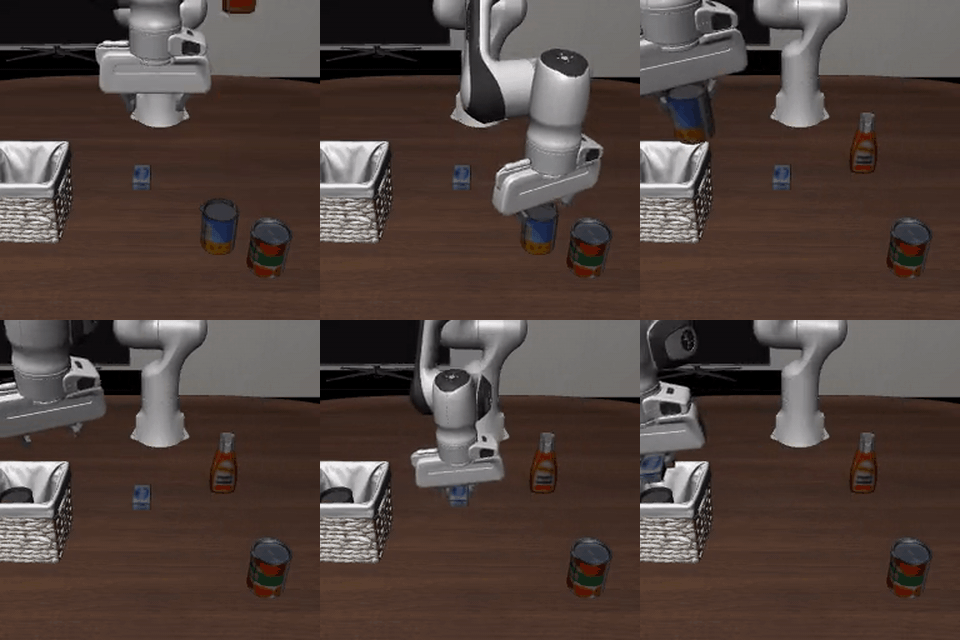
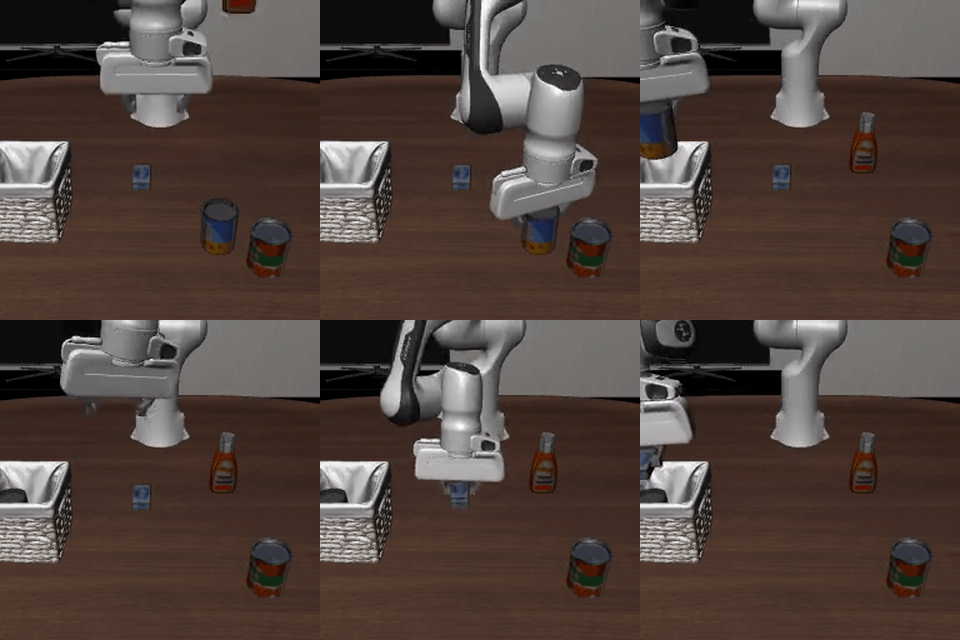
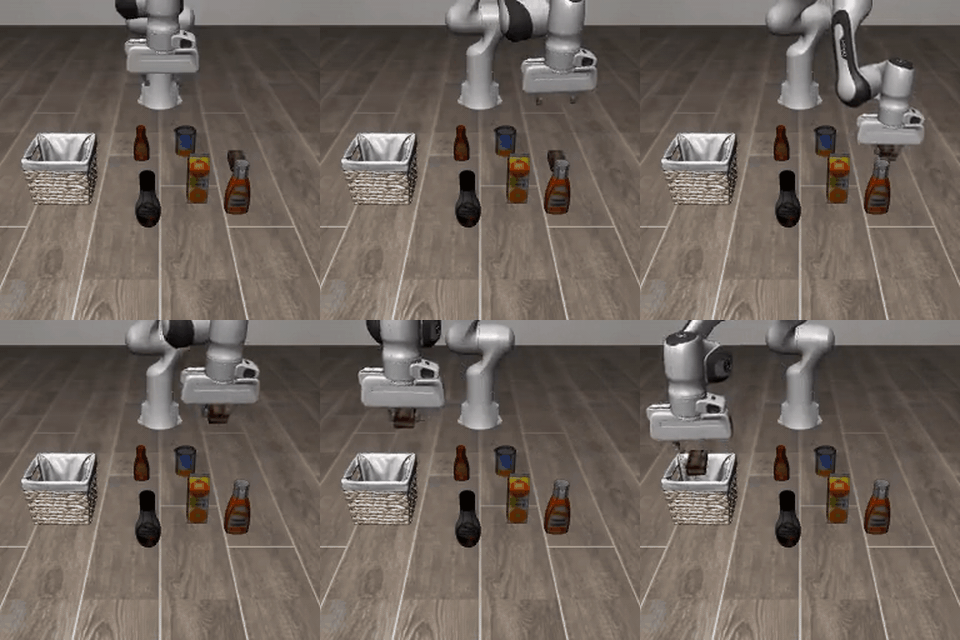
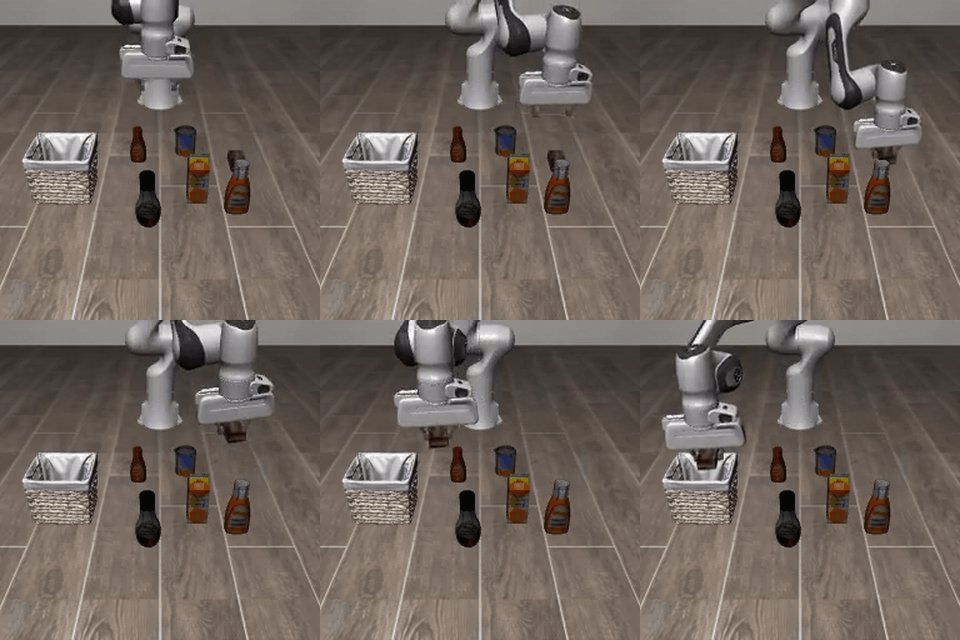
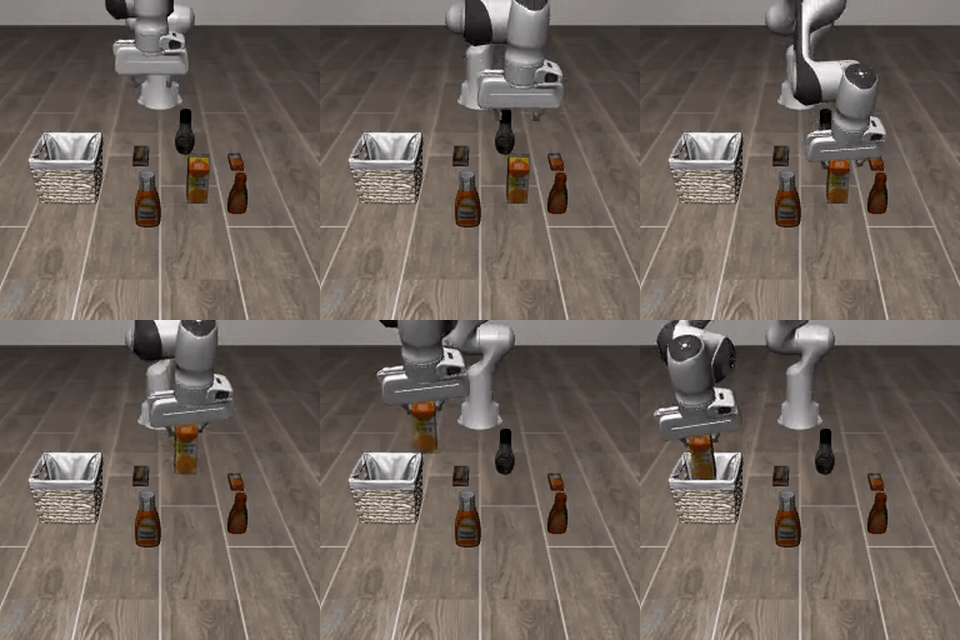
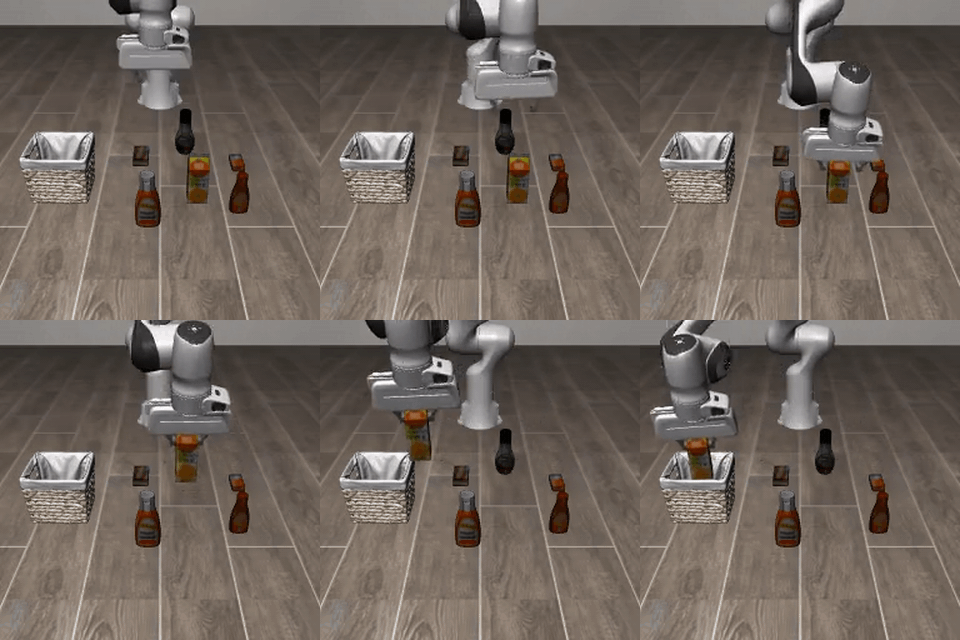
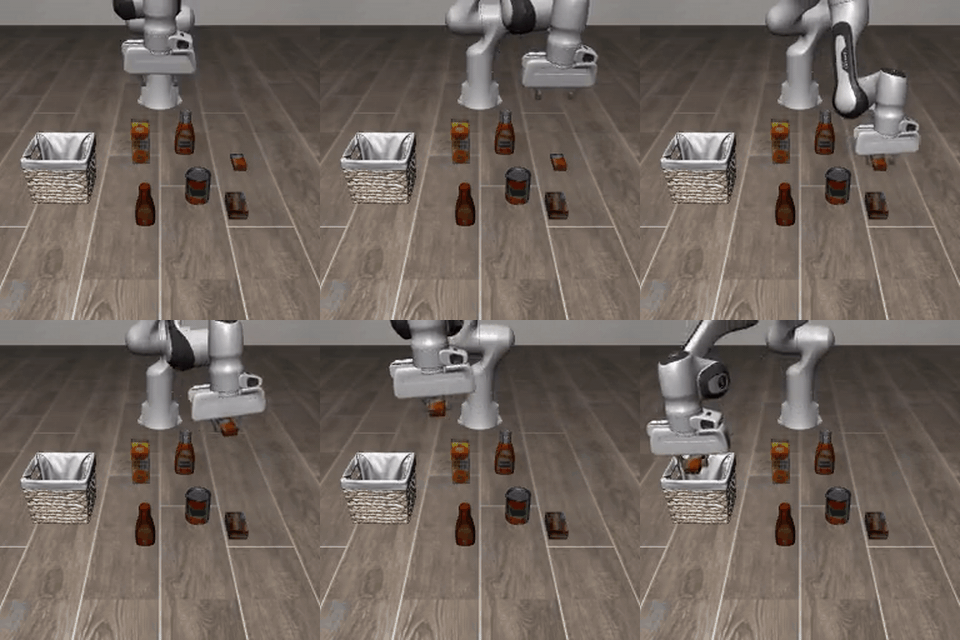
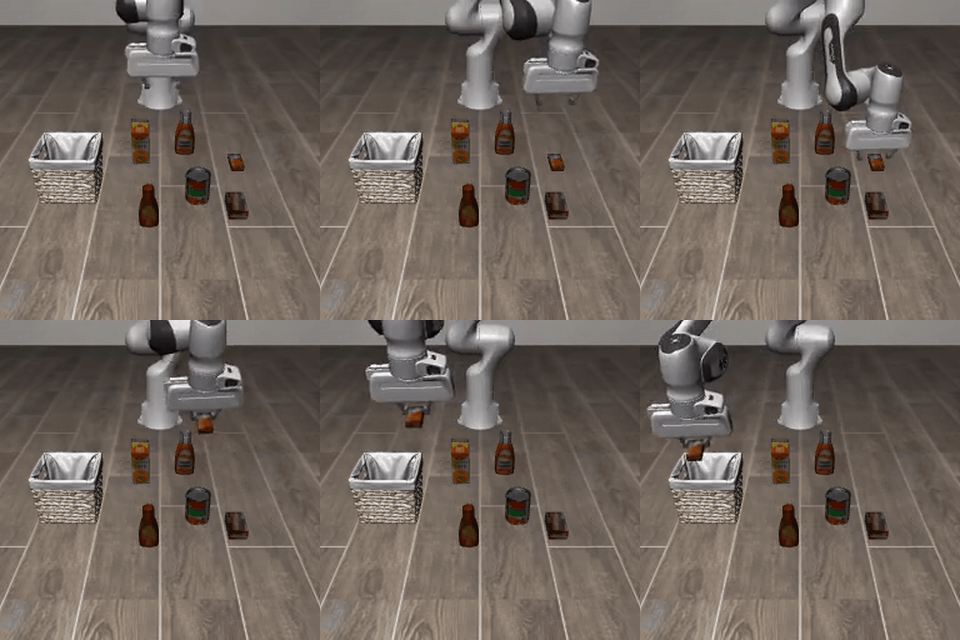
Method overview
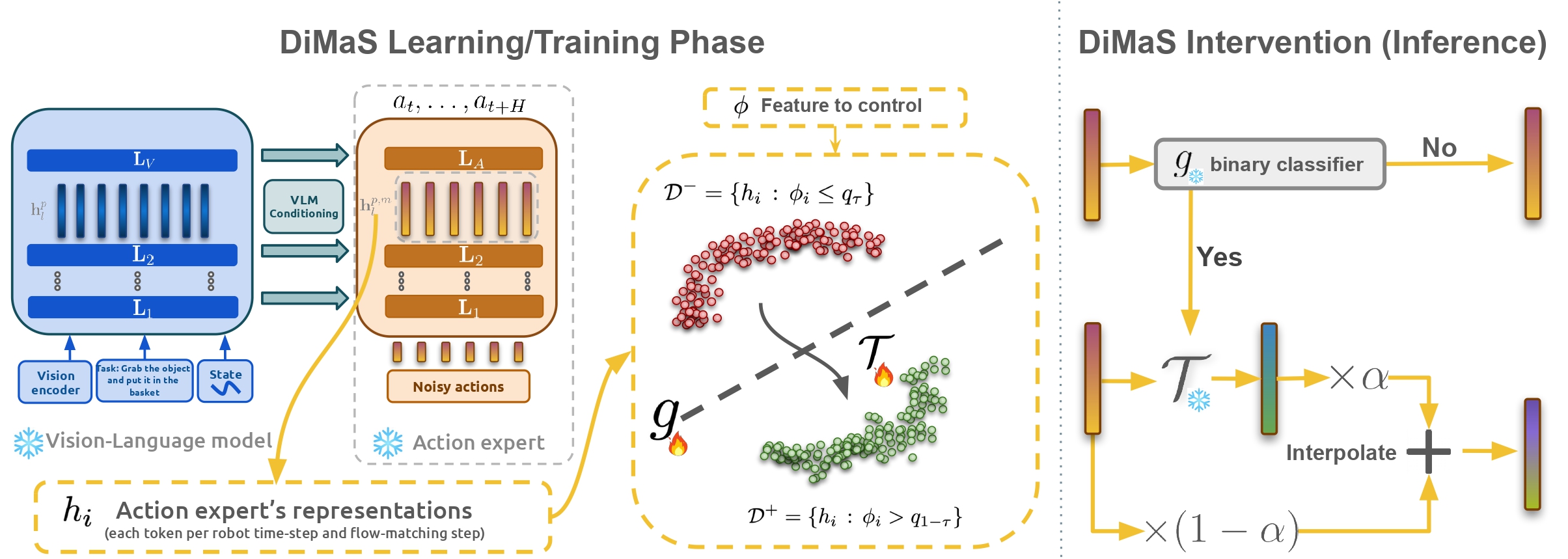
Our method details can be summarized as the following steps:
Representation and feature sourcing:
We first extract representations from a chosen layer of the flow-matching action expert (not the VLM!), across a number of tasks and episodes. Each representation is paired with a target scalar feature that denotes the behavioral property we wish to control.
Source/target distribution construction:
The complete set of extracted representations are partitioned into a source and target distribution based on the feature value. In the DiMaS illustration, this corresponds to the red/green distributions.
Learning the steering as transport map:
The underlying foundation of our steering intervention relies on a distribution matching algorithm to learn a correspondence between the two representation source/target distributions.
The main reason we opted for such a design was to ensure our steering operation could indeed move from one distribution to the other. Even though we observed a high linear separability in the action expert representations (specially in the deeper layers, later flow-matching steps), single fixed direction in the latent space was not a "good" representation of the underlying feature.
Intuitively, even though the red/green points in the DiMaS illustration above are linearly separable, moving the red points by a constant shift in any direction cannot match them completely to the green points (because the underlying geometries are different). Further details about this qualitative study can be found in the paper.
Test-time intervention strategy:
At inference time, we check whether the current representation already lies in the desired distribution (via a learned classifier between source/target distributions). If not, we transport it using the map learned offline. Rather than applying the full transport, we interpolate between the original layer output and the transported representation, giving smooth, controllable steering strength. This interpolation is essential to ensure we are able to control the feature of interest without significantly dropping the task success rate.